Chronological age vs. biological age: what's the difference?
Updated September 7, 2026 · My Birthday Almanac
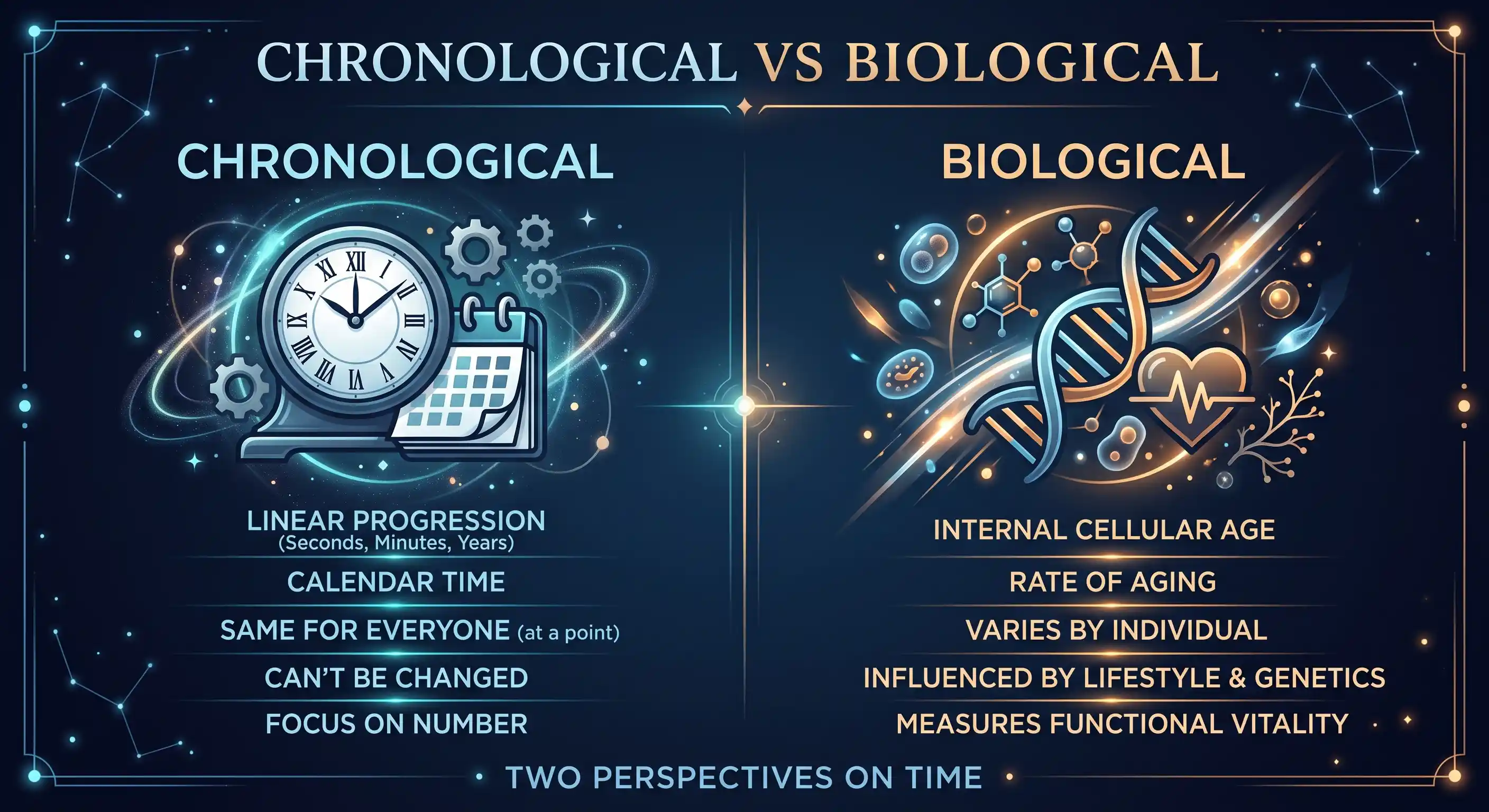
Ask “how old am I?” and there are really two answers. Chronological age is how much time has passed since you were born. Biological age is an estimate of how old your body seems to be, based on health markers. They usually differ — and understanding why is genuinely useful.
Chronological age: the calendar count
This is the everyday meaning of age: the exact years, months and days since your date of birth, counted on the standard calendar. It is objective and identical for everyone born at the same moment, and it is what the age calculator reports down to the second. It never goes down and does not care how you live. For the arithmetic behind it, see how to calculate your exact age.
Biological age: how the body is doing
Biological (or “physiological”) age tries to capture how well your body is functioning compared with population averages for each chronological age. Researchers estimate it from measurable markers, such as:
- Epigenetic clocks — patterns of DNA methylation that change predictably with age. Well-known research versions include the Horvath and Hannum clocks, and newer “second-generation” clocks such as PhenoAge and GrimAge that are tuned to predict health outcomes.
- Telomere length — the protective caps on the ends of chromosomes, which tend to shorten over time.
- Fitness and metabolic markers — cardiovascular fitness (VO₂ max), grip strength, blood pressure, resting heart rate and routine blood-test panels.
Combine these and someone who is 45 by the calendar might have a biological age of 40 — or 52.
Chronological vs biological age at a glance
- What it measures: chronological = time since birth; biological = how the body is functioning.
- How it's found: chronological = simple date arithmetic; biological = a statistical model built from biomarkers.
- Can it change direction? Chronological only ever rises; biological estimates can move up or down as health changes.
- Precision: chronological is exact; biological is an estimate with real uncertainty.
Why the two diverge
Two people born on the same day share a chronological age exactly, yet can differ in biological age by years. Broadly, the research literature associates regular physical activity, good sleep, a balanced diet and not smoking with a biological age that is younger than the calendar; chronic stress, poor metabolic health and heavy smoking are associated with the opposite. These are population-level patterns, not guarantees for any individual.
An important caveat
Biological age is an estimate from a model, not a precise readout, and different methods can disagree for the same person. Consumer “biological age” and “age-reversal” scores should be treated as rough, motivational indicators rather than diagnoses, and claims of dramatically “reversing” age should be read with healthy scepticism. For anything genuinely health-related, a clinician and proper tests beat any online estimate. Nothing here is medical advice.
What this site measures
My Birthday Almanac reports your exact chronological age, and for fun it also estimates lifetime tallies like heartbeats and breaths from population-average rates. Those are playful illustrations of scale — not a measurement of biological age or health. If you enjoy those big-number views, see your age in days, hours, minutes and seconds.