How old am I in days, hours, minutes and seconds?
Updated September 7, 2026 · My Birthday Almanac
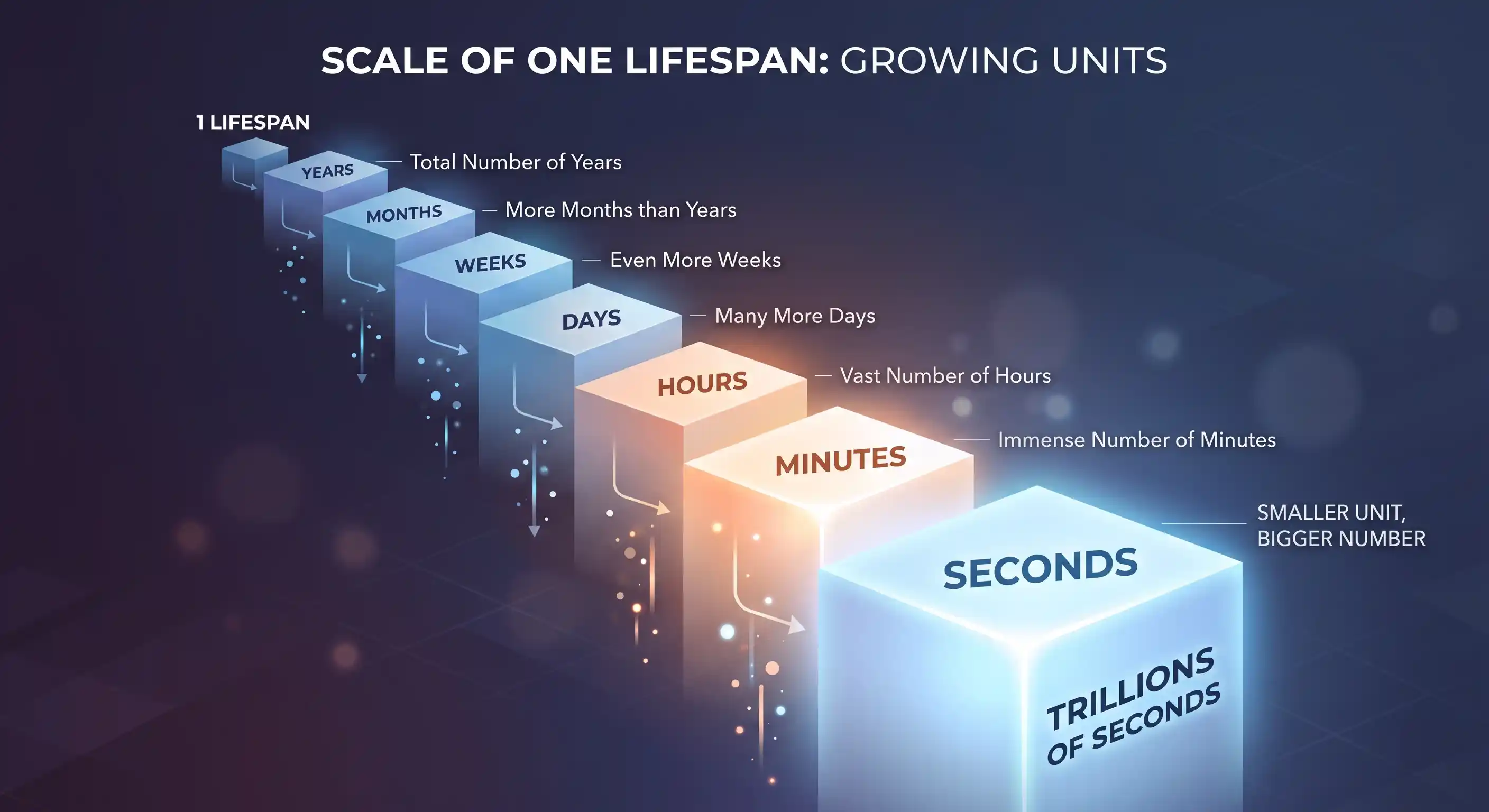
“How old am I?” usually gets answered in years. But your age is really just a length of time, and time can be measured in whatever unit you like — days, hours, minutes or seconds. The smaller the unit, the larger and faster-moving the number. Here is how each one is worked out, with conversion tables you can use for any birthday, a worked example, and the milestones worth watching for.
The idea: your age is elapsed time
Every unit comes from one simple quantity: the amount of time that has passed between the moment you were born and right now. Take that gap and express it in different units:
- Days — the total number of whole days since your birth date.
- Weeks — days ÷ 7.
- Hours — days × 24, plus the hours elapsed so far today.
- Minutes — hours × 60.
- Seconds — minutes × 60. This is the fastest-moving figure: it climbs by one every single second, which is why a live counter of it never sits still.
How many days, hours, minutes and seconds are in a year?
A single year of life is worth a surprising amount when you break it down. Averaging in leap years, one year is about 365.25 days, which gives these handy multipliers:
- 1 year ≈ 365.25 days
- 1 year ≈ 52.18 weeks
- 1 year ≈ 8,766 hours
- 1 year ≈ 525,960 minutes
- 1 year ≈ 31,557,600 seconds (about 31.6 million)
And the building blocks below the day are fixed: a day is always 24 hours, 1,440 minutes or 86,400 seconds; a week is 168 hours or 604,800 seconds.
A worked example
Suppose you were born on 14 May 1998. As a rough calculation for someone about 28 years old, that is roughly 10,300 days. Multiply through and you get about 247,000 hours, 14.8 million minutes, and 890 million seconds — all from a single date. The exact figures move every second, so the only way to be precise to the moment is to subtract your birth date from the live clock, which is what the age calculator on the home page does.
Milestone counts worth knowing
Because the units are so different in size, you hit “round number” milestones at unexpected ages. A few worth watching for:
- 1,000 days old — about 2 years and 9 months.
- 1 million minutes old — about 1 year and 11 months.
- 10,000 days old — about 27 years and 4 months.
- 1 billion seconds old — about 31 years and 8 months.
- 20,000 days old — about 54 years and 9 months.
- 2 billion seconds old — about 63 years and 4 months.
These make good “alternative birthdays.” The calculator tracks the nearest ones for your date automatically; see also how many days until your next birthday.
Why not just multiply by hand?
You can get close by hand, but two things throw a manual estimate off. First, leap years: roughly one year in four has 366 days, so a straight ×365 undercounts — over a lifetime that adds up to weeks. Second, the calendar day is not always exactly 24 hours where clocks shift for daylight saving time, so hour- and minute-level totals need care around those dates. Anchoring your birth date to local midnight and counting up to the live clock — the method the tool uses — handles both automatically.
How many days old am I?
Of all these, days are the most useful “big” unit — small enough to feel personal, large enough to be surprising. To get an exact day count, count the whole days from your birth date (at local midnight) up to today, and leap days are included for free. If you would rather see the neat years-months-days form instead, see how to calculate your exact age.
Quick answers
- How many seconds have I lived? Roughly your age in years × 31.56 million. A 30-year-old has lived about 947 million seconds.
- How many hours are in a year? 8,766 on average (8,760 in a common year, 8,784 in a leap year).
- How many minutes have I been alive? About your age in years × 525,960.