The Desi (Punjabi Bikrami) calendar: all 12 months explained
Updated September 7, 2026 · My Birthday Almanac
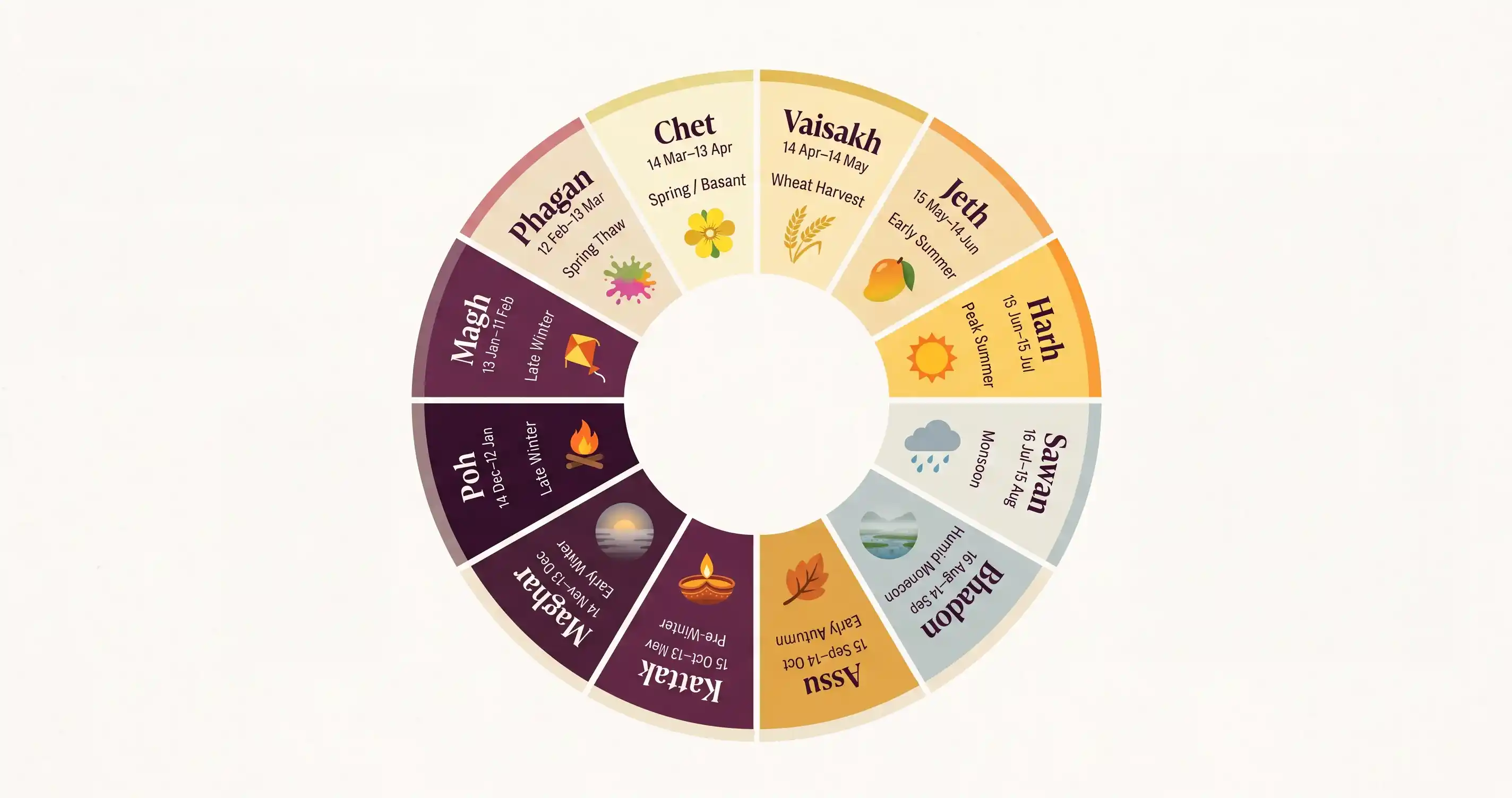
Across Punjab and much of North India and Pakistan, everyday life, farming and festivals still follow the Desi calendar — the solar reckoning of the Bikrami (Vikram Samvat) system. Its twelve months, from Chet to Phagan, are tied to the seasons rather than to the Gregorian dates most of the world uses. Here is how it works and what each month means.
What is the Bikrami (Desi) calendar?
The Bikrami era traditionally counts from 57 BCE, which is why its year number runs about 57 ahead of the Gregorian year. It exists in both lunar and solar forms; the solar version — the one Punjabis call the Desi calendar — is what governs the agricultural year. Like the Gregorian calendar it tracks the Sun, so its months stay locked to the seasons: Sawan is always the monsoon, Poh is always deep winter.
How the solar months work
Each Desi month begins as the Sun enters a new sign of the sidereal zodiac (an event called sangrand, which many mark as the first of the month). In everyday use the months line up with fixed stretches of the Gregorian calendar — for example, Chet begins around 14 March every year. Because the month is set by the Sun's position, a birth date always falls in a single, predictable Desi month.
The twelve Desi months
Here are all twelve in order, with their Urdu spelling, the dates they cover and what marks them:
- Chet (Chait) (چیت) — 14 Mar – 13 Apr · Basant · Spring. Punjabi New Year. Blooming mustard fields and the season of Sufi romantic poetry.
- Vaisakh (ویساکھ) — 14 Apr – 14 May · Wheat Harvest. Vaisakhi festival, the golden wheat harvest, and the beat of traditional Bhangra.
- Jeth (Jyeshtha) (جیٹھ) — 15 May – 14 Jun · Early Summer Peak. The hottest stretch begins — melons and the beloved mango season arrive.
- Harh (Ashadha) (ہاڑ) — 15 Jun – 15 Jul · Scorching Mid-Summer. Longing for the monsoon; a month of endurance celebrated in folklore.
- Sawan (ساون) — 16 Jul – 15 Aug · Monsoon · Varsha. Teej festival, banyan swings, Kheer-Poore, and the poetry of the rains.
- Bhadon (بھادوں) — 16 Aug – 14 Sep · Humid Monsoon · Umas. Flooded paddy fields; Raksha Bandhan and Janmashtami celebrations.
- Assu (Asoo) (آسو) — 15 Sep – 14 Oct · Early Autumn. Crisp mornings and the Navratri / Dussehra season.
- Kattak (Katak) (کتک) — 15 Oct – 13 Nov · Pre-Winter · Sharad. Diwali & Bandi Chhor Divas, earthen diyas, and winter wheat sowing.
- Maghar (مگھر) — 14 Nov – 13 Dec · Early Winter. Foggy dawns, Makki di Roti & Sarson da Saag, and village fairs.
- Poh (پوہ) — 14 Dec – 12 Jan · Deep Winter · Shishir. Freezing nights, Lohri bonfires, Til, Gur, and warming folk songs.
- Magh (ماگھ) — 13 Jan – 11 Feb · Late Winter · Thaw. Maghi / Makar Sankranti and Basant Panchami kite flying.
- Phagan (پھگن) — 12 Feb – 13 Mar · Spring Thaw. Holi & Hola Mohalla, vibrant colours, and a farewell to winter.
A calendar of festivals
Because the months follow the seasons, so do the festivals. Vaisakh brings Vaisakhi and the wheat harvest; Sawan brings Teej and the monsoon swings; Kattak brings Diwali and Bandi Chhor Divas; Poh ends with Lohri bonfires; and Phagan brings Holi and Hola Mohalla. Knowing your Desi month is a lovely way to place your birthday in this seasonal and cultural rhythm.
How to find your Desi month
You do not need to convert dates by hand. Enter your date of birth in the age calculator and it shows the Desi Bikrami month you were born under — in Urdu and Roman script, with its season and significance — alongside your Islamic Hijri date, Chinese zodiac and more.
Related reading
The Desi calendar is solar, like the Gregorian one; for the two other systems the almanac converts your birthday into, see the Islamic Hijri calendar explained and the 27 Vedic Nakshatras.